Special allowance is one of the most common—and most misunderstood—components of a salary structure in India. Often called the "catch-all" of salary components, it's the flexible bucket that absorbs whatever remains after you've allocated Basic, HRA, DA, and other specific allowances from the CTC.
For a mid-level employee with a CTC of ₹12 Lakhs, the special allowance might constitute 15–25% of the gross salary. Yet many employees don't fully understand how it works, how it's taxed, or how to optimize it.
In this guide, we'll break down everything you need to know about special allowance in salary—from its meaning and calculation to tax implications and best practices for structuring it.
What is Special Allowance in Salary?
Special allowance is a fixed monetary component paid to employees over and above their basic salary. It is typically offered to meet specific expenses or as additional compensation for the nature of the job. In practice, it's the residual component that fills the gap between an employee's CTC and the sum of all other salary heads.
💡 Quick Definition: Special allowance is the amount that remains after an employer has allocated fixed portions to basic salary, HRA, DA, and other defined heads. It is fully taxable and does not offer any specific tax exemption unless it falls under a government-issued exemption list.
Employers typically compute special allowance as the residual amount needed to reach the agreed gross or CTC figure once fixed components like Basic, HRA, and DA are set.
A question on Reddit's r/IndiaTax captures that confusion well. A user shared their salary breakup and asked the community to explain what the different components actually meant, including basic salary, HRA, flexible allowance, employer PF, and performance bonus.
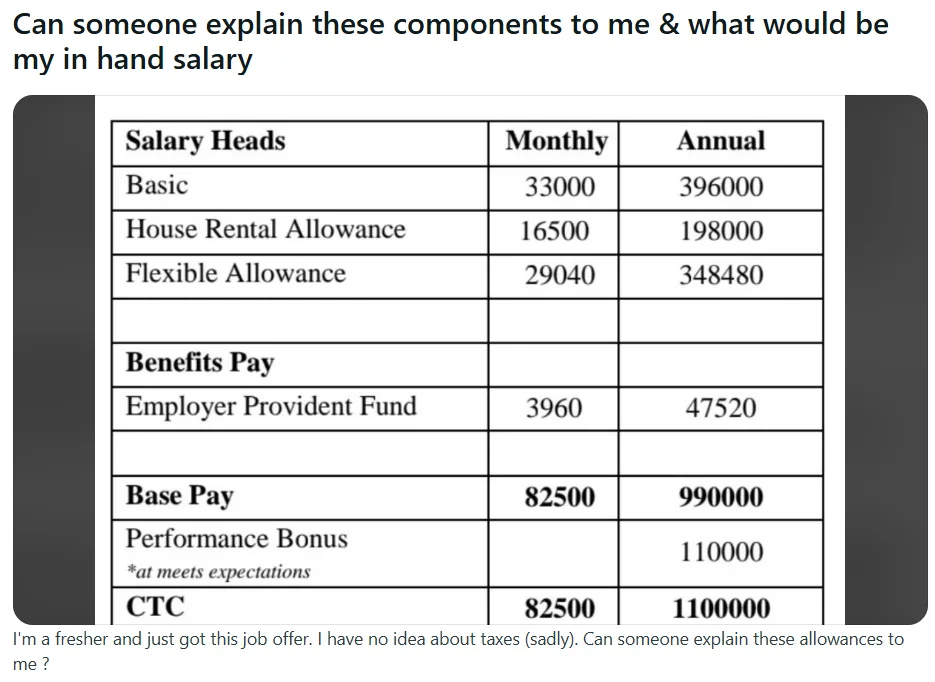
Source: Reddit For someone looking at these components for the first time, it's easy to assume they're all just different ways of describing the same thing. They're not. Some have defined formulas or exemption rules. Others are simply part of taxable salary, and their treatment can also affect statutory calculations such as PF and gratuity. That distinction is at the heart of special allowance. This guide explains how it fits into your CTC, when it is taxable, how Section 10(14) exemptions work, and what the Labour Codes mean for its treatment in PF and gratuity.
Special Allowance vs. Other Allowances
Unlike House Rent Allowance (HRA) or Leave Travel Allowance (LTA), which offer specific tax exemptions under the Income Tax Act, special allowance is fully taxable in most cases.[reference:7] It does not have a dedicated exemption section, making it a less tax-efficient component compared to allowances like HRA, LTA, or medical reimbursements.
However, this also makes it the most flexible component—employers can adjust it easily without impacting other statutory calculations.
How is Special Allowance Calculated?
The calculation of special allowance is straightforward:
📐 Formula:
Special Allowance = Gross Salary − (Basic Salary + HRA + DA + Conveyance + Medical Allowance + Other Specific Allowances)
In other words, it's the balancing figure that ensures the total of all salary components equals the agreed CTC or gross salary.
Example Calculation
Consider an employee with the following salary structure:
| Component | Amount (₹ per month) |
|---|---|
| Basic Salary | 50,000 |
| HRA (40% of Basic) | 20,000 |
| Conveyance Allowance | 3,000 |
| Medical Allowance | 2,000 |
| Special Allowance | 15,000 |
| Gross Salary | 90,000 |
Here, the special allowance of ₹15,000 is the residual amount that bridges the gap between the sum of other components (₹75,000) and the gross salary (₹90,000).
Taxation of Special Allowance
Is Special Allowance Taxable?
Yes, special allowance is fully taxable under the Income Tax Act, unless it falls under a specific exemption notification issued by the government.
Under Section 2(24)(iiia) of the Income Tax Act, special allowances are generally treated as part of "income" and are subject to tax at the employee's applicable slab rate.
⚠️ Important: Unlike HRA or LTA, special allowance does not offer any automatic tax exemption. It is added to your total taxable income and taxed accordingly. This is why many HR experts recommend minimizing the special allowance component and maximizing tax-exempt allowances where possible.[reference:11]
Impact on Provident Fund (PF)
For employees whose Basic + DA + Special Allowance is less than ₹15,000 per month, PF contribution is mandatory. However, for employees above this threshold, PF is calculated only on the Basic + DA component—special allowance is not included in PF calculations in most cases, unless the employer specifically includes it.
New Tax Regime vs. Old Tax Regime
Under the new tax regime (default from FY 2023-24), most deductions and exemptions are not available. This means special allowance is taxed at the slab rate without any deduction benefits. Under the old tax regime, you can claim deductions under Section 80C, 80D, etc., but special allowance itself remains fully taxable.
How to Optimize Your Special Allowance with Pravah HRMS
Since special allowance is fully taxable, optimizing your salary structure can help you maximize take-home pay and minimize tax liability. Here are some strategies:
1. Increase Tax-Exempt Components
Where possible, restructure your salary to increase components like HRA, LTA, medical reimbursements, and food coupons, which offer partial or full tax exemptions. This reduces the residual amount that falls into special allowance.
2. Opt for Tax-Saving Investments
Under the old tax regime, you can reduce your overall tax liability by investing in Section 80C instruments (PPF, ELSS, life insurance, etc.). While this doesn't directly affect special allowance, it lowers your total tax outgo.
3. Negotiate Your Salary Structure
When joining a new company or during annual appraisals, negotiate the composition of your salary package. Request a higher Basic or HRA component instead of a larger special allowance—this can improve your tax efficiency in the long run.
💡 Pro Tip from Pravah HRMS: Many companies load too much into Special Allowance because it's fully taxable and easy to adjust. Structuring HRA, LTA, and other exempt components optimally can significantly boost your take-home pay. Use Pravah HRMS's payroll and HRMS tools to model different salary structures and see the impact on your net income.
Special Allowance in Payroll Processing with Pravah HRMS
For HR and payroll teams, managing special allowance efficiently is critical for accurate salary processing. Pravah HRMS automates this entire process. Here's how it typically works in a payroll system:
1. Salary Structure Definition
Special allowance is defined as a fixed or variable component in the employee's salary structure. It can be a percentage of Basic or a flat amount.
2. Proration and Adjustments
When an employee joins or leaves mid-month, or takes leave without pay (LOP), the special allowance is typically prorated based on the number of working days. Some payroll systems also allow adjusting the difference amount created due to LOP against the special allowance.
3. Tax Deduction at Source (TDS)
Special allowance is included in the gross salary for TDS calculation. Employers must ensure accurate tax deduction by considering the employee's total taxable income, including special allowance.
4. Payslip Generation
Special allowance appears as a separate line item on the employee's payslip, clearly showing the amount and any adjustments made during the month.
Frequently Asked Questions
Is special allowance part of basic salary?
No. Special allowance is a separate component and is not considered part of basic salary. Basic salary is the fixed component that forms the basis for many other calculations like PF, gratuity, and bonus.
Can special allowance be exempt from tax?
Generally no. Special allowance is fully taxable unless it falls under a specific government notification granting exemption under Section 10(14). Most special allowances do not qualify for exemption.]
What is the difference between special allowance and personal allowance?
Personal allowance is a fixed amount given to employees to meet personal expenses and is also fully taxable. The terms are often used interchangeably, but "special allowance" is more commonly used in Indian salary structures.
Does special allowance affect PF contribution?
For employees with Basic + DA + Special Allowance below ₹15,000, PF is calculated on the total. For others, PF is typically calculated only on Basic + DA, and special allowance is excluded from PF contributions.
How can I reduce my special allowance?
You can request your employer to restructure your salary by increasing tax-exempt components like HRA, LTA, or medical reimbursements. This reduces the residual amount allocated to special allowance.