Back to Blogs
PravahERP Blogs
Insights, tips, and industry trends on ERP solutions, business management, and digital transformation.
Insights, tips, and industry trends on ERP solutions, business management, and digital transformation.
Struggling with Excel sheets? Learn how HRMS software helps Indian SMEs automate payroll, track attendance, and manage statutory compliance like PF, ESI, and TDS effortlessly.
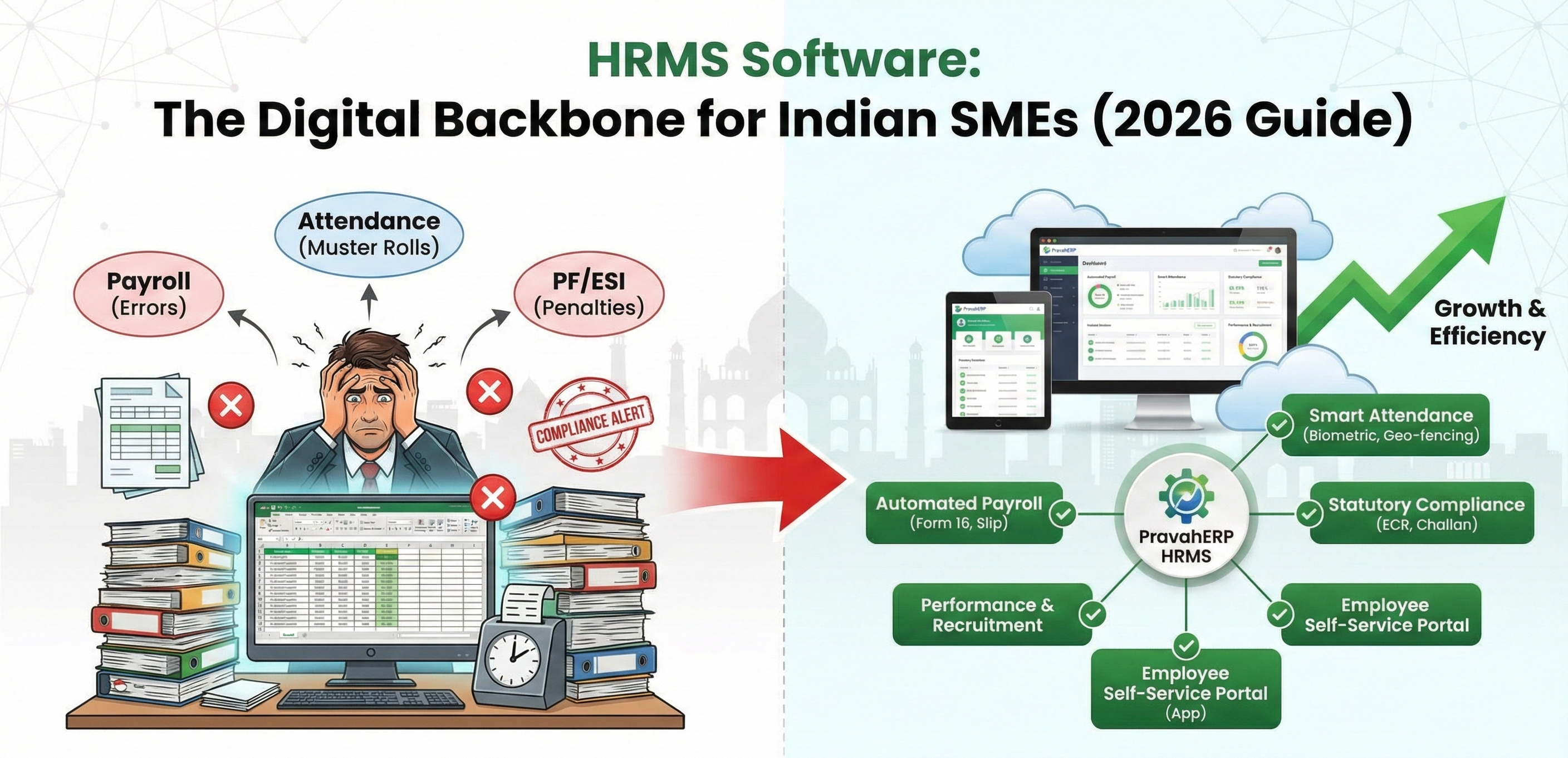
For many small businesses in India, managing a growing workforce using spreadsheets is a recipe for disaster. Manual data entry often leads to salary miscalculations, lost attendance records, and compliance penalties. HRMS software (Human Resource Management System) is the solution—a centralized digital platform that automates every aspect of employee management, from "hire to retire."
Whether you have 10 employees or 500, adopting an HRMS reduces administrative burden by automating repetitive tasks, ensuring your HR team can focus on people, not paperwork.
HRMS software is an integrated suite of applications that manages the complete employee lifecycle. It acts as a single source of truth for all employee data. Unlike standalone tools that operate in silos, a modern HRMS connects your attendance data directly to payroll, ensuring zero errors in salary processing.
While a standard payroll management system only calculates salaries, a full HRMS handles hiring, attendance, payroll, leave and outduty request and approval flow, incentive and overtime in one single dashboard.
A complete HRMS solution typically consists of five key pillars designed to streamline operations:
Payroll is the heart of any HRMS. It automates the complex calculation of gross-to-net salaries, accounting for earnings (Basic, HRA, DA, Allowances) and deductions (PF, ESI, PT, TDS). Advanced systems also generate Form-5, Form-10 saving your finance team days of manual work.
Gone are the days of manual muster rolls. HRMS software captures real-time attendance via biometric devices or mobile apps with geo-fencing for field staff. It automatically calculates paid days, overtime, and loss of pay (LOP), syncing this data directly with payroll to ensure accurate salary disbursement.
India's labor laws are complex and frequently changing. An HRMS ensures you stay compliant by automatically calculating Provident Fund (PF), ESIC, Professional Tax, and Labour Welfare Fund (LWF). It can generate ready-to-file Electronic Challan cum Return (ECR) files, saving you from heavy penalties associated with non-compliance.
Empower your workforce with transparency. An ESS portal allows employees to view their payslips, download tax sheets, apply for leave, and regularize attendance without constantly emailing the HR department. This self-service approach significantly reduces the query resolution time for HR managers.
Beyond operations, HRMS helps in strategic growth. It streamlines the hiring process by tracking candidate pipelines and simplifies performance reviews with goal setting and appraisal workflows, helping you retain top talent.
Indian SMEs operate in a highly competitive and regulated environment. Relying on manual processes limits your ability to scale. Implementing HRMS software provides immediate ROI by:
Many growing businesses delay adopting HRMS software until operational problems become serious. However, upgrading at the right time can prevent payroll errors, compliance penalties, and employee dissatisfaction.
You should consider upgrading to an HRMS solution if:
Implementing a cloud-based HRMS early allows businesses to scale confidently while maintaining accuracy, compliance, and operational efficiency.
HRMS software is no longer a luxury for Indian SMEs—it is a necessity for businesses aiming to scale efficiently while staying compliant...
Stop wasting time on spreadsheets. Experience the power of PravahERP, the all-in-one HRMS solution designed for Indian businesses.
Request a Free DemoGet started with PravahERP today and experience the power of integrated ERP solutions.